How the Unbinder Market Reference works
One shared method sits behind Unbinder price histories, card comparisons, sealed-product graphs, and set-performance articles.
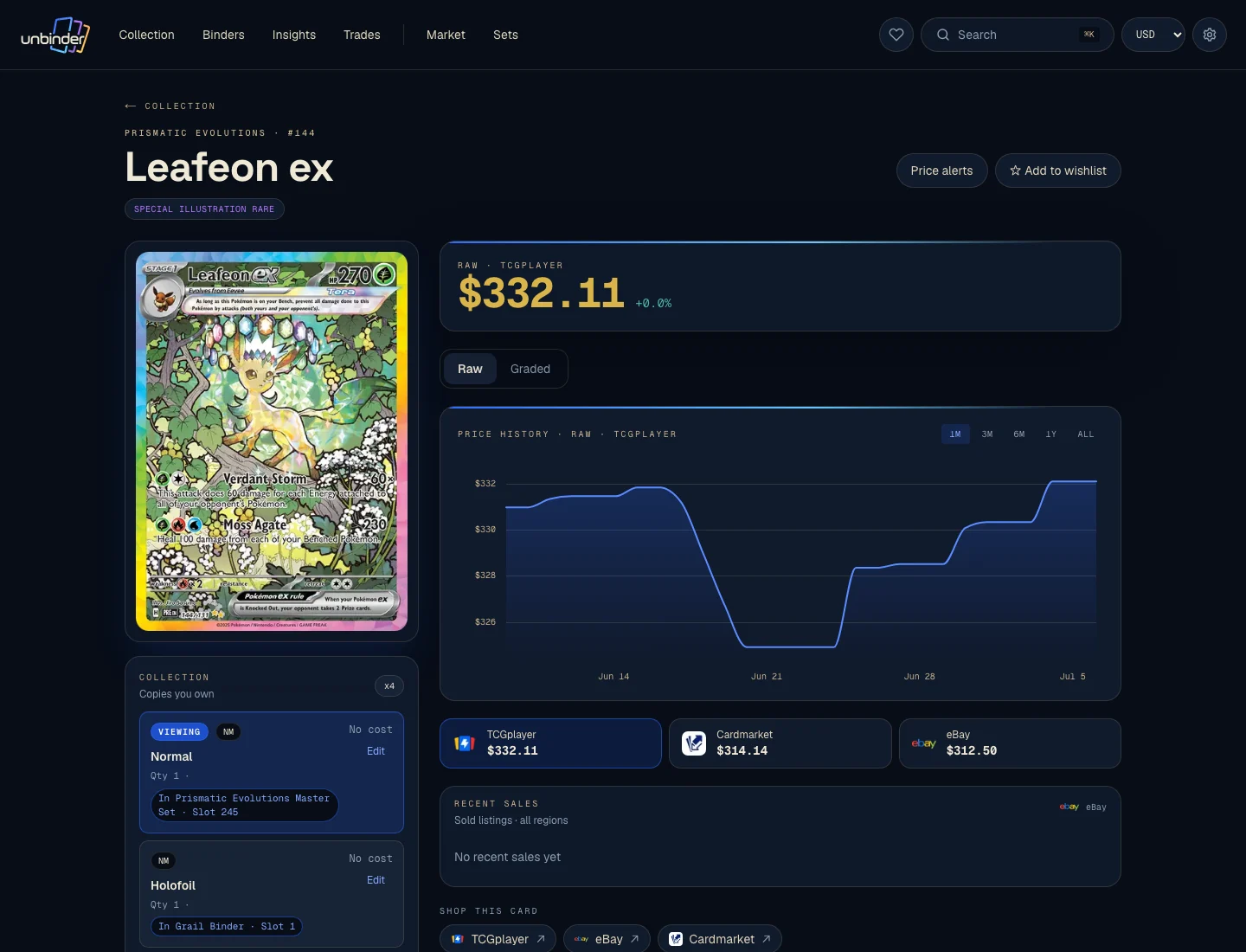
The Unbinder Market Reference is a reviewed, dated price indicator for one identified card, printing, or sealed product. It is designed to help collectors compare movement and context. It is not an official price, a guaranteed sale value, or a substitute for checking the copy or listing in front of you.
This page is the shared method behind Unbinder market-history charts, card-versus-card graphs, sealed-product comparisons, and set-performance articles. Individual articles still state their own dates, sample, coverage, and exclusions.
What the reference is
A useful reference starts with identity. For a card, Unbinder matches the set, collector number, language, printing, condition, and grade when the evidence supports those details. For sealed products, the product version matters just as much: a regular Elite Trainer Box and a Pokémon Center Elite Trainer Box are separate products even when they belong to the same expansion.
We then keep a dated history for that identified item. The displayed number is context for a collecting decision, not a promise that every seller, buyer, country, or card condition will produce the same amount.
Marketplace observations can disagree for honest reasons. TCGplayer mainly reflects US marketplace activity, Cardmarket adds European asking-price context, and eBay can show active listings or completed-sale evidence. Unbinder reviews and publishes its own charts and conclusions from the evidence available to it. We do not average unlike markets, currencies, asking prices, and completed sales into one mystery number.
How we match a card or sealed product
The first check is whether both sides describe the same thing. A name alone is not enough. “Mega Greninja ex” can refer to more than one collector number. “Chaos Rising ETB” can mean the standard box or the Pokémon Center version.
For cards, we prefer exact set and collector-number matches, then keep language, finish, condition, and grade separate. For sealed products, we match the product category and version before attaching history or a marketplace destination. When a reviewed match is not available, the article should show an unavailable state or a clearly labelled search instead of pretending that a nearby result is exact.
Catalog images are presentation, not price evidence. Unbinder uses reviewed catalog records and licensed images where available. An image helps confirm the product, but the underlying name, number, variant, and product record are what keep the comparison honest.
The card these rules are written against
Every rule below exists because of cards like Charizard ex 223/197: a printing with close siblings in its own set, sold in two currencies, across markets that measure different things. Get the identity wrong and every downstream number is wrong in a way no amount of statistical care recovers.
That is also why we never average across sources. TCGplayer's Market Price (opens in a new tab) is a rolling average of completed sales; Cardmarket's price data (opens in a new tab) reflects active European listings. Both are useful, and a mean of the two describes no market that exists.
Card showcase
The printing every rule on this page was written against
Check the set and collector number, compare prices from each marketplace, and decide whether the card belongs on your wishlist or in your binder. One active listing is never the whole market.
Some marketplace links may earn us a commission at no extra cost to you. Compare condition, language, shipping, taxes, and sold results before buying.
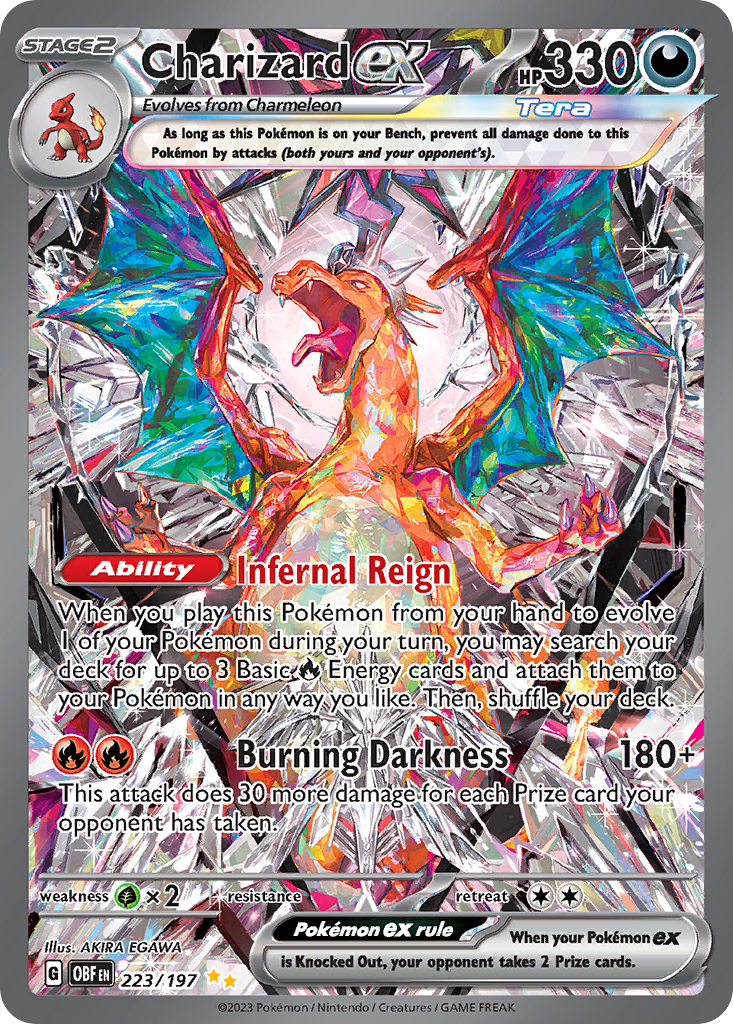
Charizard ex
Special Illustration Rare · EN
Use as a cross-source benchmark: movement matters more when TCGplayer, Cardmarket, and eBay agree.
Marketplace price check
Checking saved data



Next step: Confirm the card version and condition before comparing prices.
Catalog source: Pokemon TCG API card record - Reviewed 2026-07-09
How we build a comparison
Two lines belong in the same graph only when their dates, metric, currency, and unit are comparable. A card-versus-card chart uses aligned checkpoints. A sealed-versus-sealed chart compares sealed products only. Singles and sealed products may appear in one article, but they remain separate panels because they answer different questions.
Indexed mode gives both series a starting value of 100. That makes the shape of the movement easier to compare when the dollar prices are far apart. It does not mean the products started at the same price. Absolute mode keeps the original currency visible.
Set comparisons require a frozen basket. We choose the eligible cards before calculating the result, require at least 20 eligible cards per set, and require usable start-and-end observations for at least 80% of each basket. The headline result is the median percentage change. We also publish how many measured cards rose, fell, or stayed approximately flat, because one median cannot describe the whole set.
The Mega Evolution versus Phantasmal Flames comparison shows that method on two full sets. The Chaos Rising ETB comparison shows the same date-alignment principle on two sealed products.
What every article must disclose
Every original Unbinder market article should make the evidence inspectable without exposing private collector data or republishing an upstream database. The article or its data tool states:
- the exact cards, sets, or sealed products being compared;
- the observation window and review date;
- the currency, condition, grade, and metric;
- the eligible and measured counts when coverage matters;
- exclusions, missing observations, and known limitations;
- whether a statement is an observation, interpretation, or recommendation.
Charts also carry a checksum for the reviewed data shown on the page. The checksum is a change detector, not proof that a market number is universally correct. If the reviewed series changes, the checksum changes with it.
What the reference cannot tell you
The Unbinder Market Reference cannot inspect the centering, whitening, surface wear, seal condition, seller reputation, taxes, or shipping cost of the item you are considering. It cannot guarantee what another collector will pay tomorrow. A thin market can also move sharply because only a small number of comparable items were available.
Use the reference to ask a better next question: is this the same product, is the condition comparable, is the movement broad or driven by one early observation, and does this purchase fit the collection goal?
For expensive decisions, compare the exact marketplace listing as well as the dated history. The guide to Pokemon card price sources explains when each marketplace is most useful.
Corrections and review cadence
This method is reviewed quarterly and whenever Unbinder changes a public market metric, comparison rule, or catalog-matching rule. Volatile articles have their own earlier review date. If a product match, calculation, or label is corrected, we update the article and the reviewed data together.
The current method was reviewed on July 29, 2026. It applies to public Unbinder editorial charts and comparisons unless an article states a narrower method.
Continue this workflow
Mega Evolution vs Phantasmal Flames price performance