Pokemon set collector checklist: what to track at release
A new set is easier to collect when you separate excitement from the actual checklist.
When a new Pokemon set releases, track the set facts, your collecting goal, owned cards, missing cards, chase cards, price context, and buy-or-wait decisions separately. That keeps launch hype from turning into duplicate purchases and messy binders.
Reuse this checklist whenever a new set launches. It separates facts that can be confirmed on day one from prices and availability that need another look after release-week noise settles.
Browse active release coverage in the Set Guides & News hub. Use this page when you need the method behind those set-specific articles.
Who this is for
This guide is for collectors who want a new set to become a clear plan instead of a pile of opening notes. It is especially useful if you are deciding whether to build a master set, chase a few favorites, buy sealed products, wait for singles, or track price movement after launch.
Anchor every set guide to a verifiable printing
The template only works if each guide names at least one card a reader can check away from the page. Charizard ex 223/197 from Obsidian Flames is the worked example here: a card with siblings in its own set, so it forces the guide to be precise about numbering rather than about names.
Every guide built from this template cites the set's official checklist, the way the official Obsidian Flames card list (opens in a new tab) and 151 card list (opens in a new tab) are cited here. A set guide that cannot be checked against the printed list is a summary of other people's summaries.
Card showcase
The worked example every set guide in this template uses
Check the set and collector number, compare prices from each marketplace, and decide whether the card belongs on your wishlist or in your binder. One active listing is never the whole market.
Some marketplace links may earn us a commission at no extra cost to you. Compare condition, language, shipping, taxes, and sold results before buying.
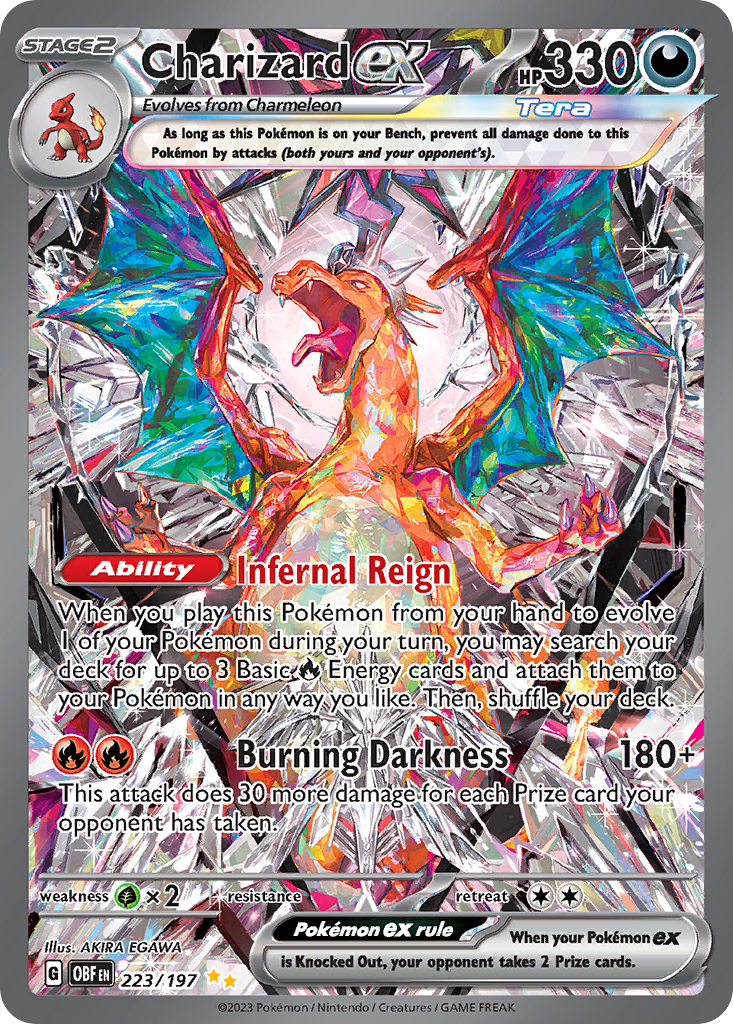
Charizard ex
Special Illustration Rare · EN
Use as a cross-source benchmark: movement matters more when TCGplayer, Cardmarket, and eBay agree.
Marketplace price check
Checking saved data



Next step: Confirm the card version and condition before comparing prices.
Catalog source: Pokemon TCG API card record - Reviewed 2026-07-09
Quick structure for every set guide
| Section | What it should answer |
|---|---|
| Set facts | Name, release date, era, product types, card count |
| Collector goal | Standard set, master set, favorite Pokemon, sealed, or singles |
| Checklist | Owned cards, variants, reverse holos, promos, and missing cards |
| Chase cards | Cards collectors are most likely to watch or wishlist |
| Buy strategy | Packs for fun, singles for exact gaps |
| Price watch | TCGplayer, Cardmarket, and eBay context with review dates |
| Unbinder workflow | Scan, track progress, build wishlist, review value |
For the baseline checklist method, read Pokemon set checklist: how to complete a set.
Interactive set binder
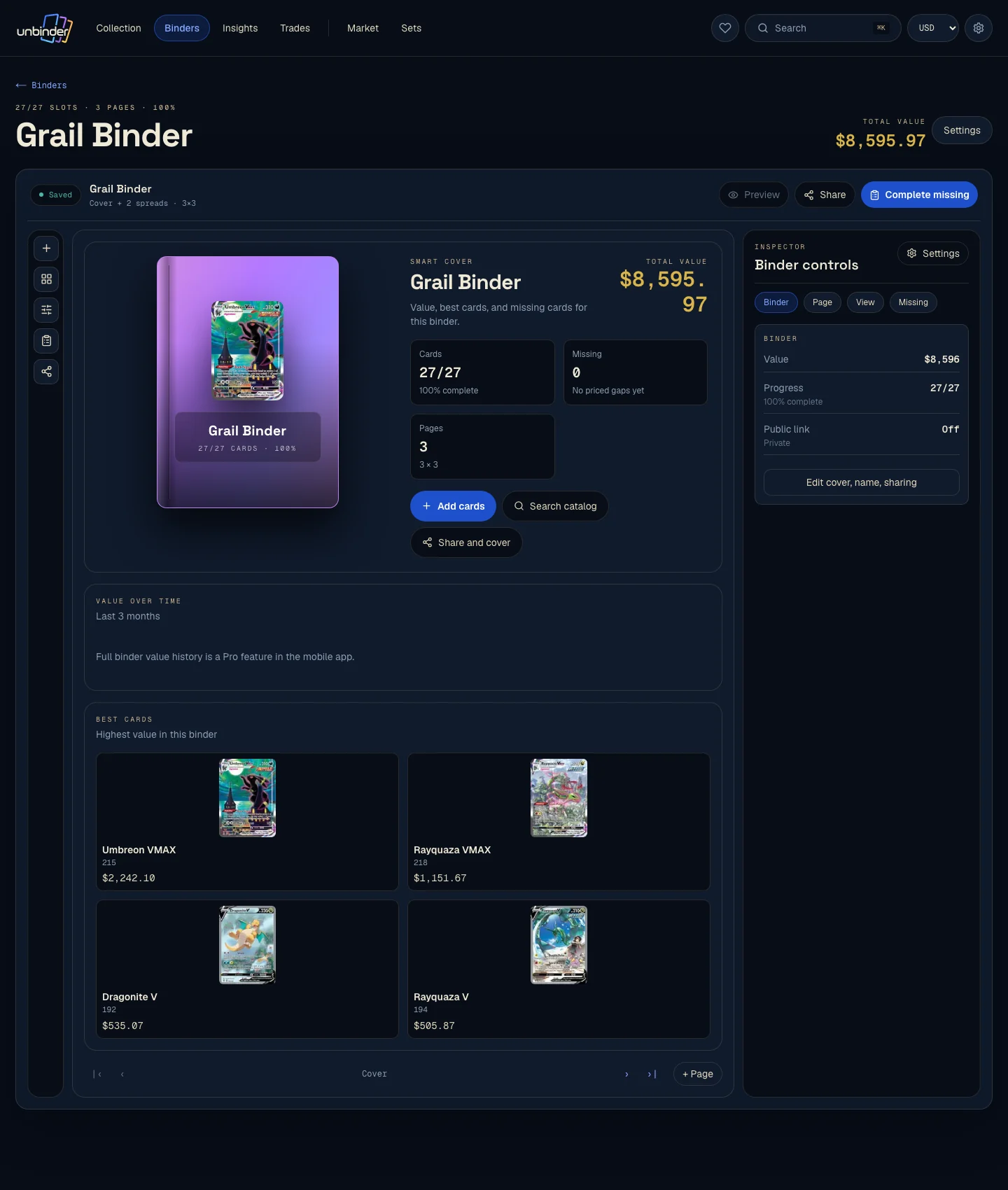
Turn a release template into a set binder
Start a set binder from this guide, then keep owned cards, missing cards, and price context together in Unbinder.
Check the facts before you buy
This checklist was reviewed on July 15, 2026. Product contents, release dates, card lists, and marketplace conditions can change, so confirm volatile details against a dated source before spending money.
Use these source types when researching a set:
- Official Pokemon product and set pages for confirmed product details.
- Official retailer or Pokemon Center pages when product contents matter.
- Pokebeach and PokeGuardian for release context, reveal timing, and community news trails.
- TCGplayer, Cardmarket, and eBay sold/listing context for dated price-watch sections.
Do not treat rumored release dates, unconfirmed card counts, or copied card lists as facts. Keep them off the buying plan until a reliable source confirms them.
A release-week collector routine
Use the same flow for every new Pokemon set:
| Moment | What to do | What to avoid |
|---|---|---|
| Before the full list | Track confirmed products and revealed cards | Treating leaks as final checklist |
| When the checklist lands | Create owned, missing, reverse, promo, and chase rows | Mixing every goal into one list |
| Release week | Scan pulls and separate duplicates | Buying every missing card immediately |
| First price check | Compare TCGplayer, Cardmarket, and eBay context | Calling early listings stable value |
| Restock or second wave | Revisit sealed supply and expensive singles | Assuming launch-week scarcity remains |
The goal is not to predict the market perfectly. The goal is to make the next collector decision visible.
Start with set facts
A useful set guide should make the basics obvious:
- Official set name.
- Release date and region.
- Era or series.
- Main product types.
- Number of cards.
- Notable promos or special products.
- Whether reverse holos, stamped cards, or special variants matter.
Do not bury these facts under hype. Collectors need a clean reference before they decide what to buy.
Define the collecting goal
Not every reader wants the same set. A good guide should separate goals:
- One of every numbered card.
- Master set with reverse holos and variants.
- Favorite Pokemon or artist subset.
- Sealed product collection.
- Wishlist of chase cards only.
- Budget binder for favorite artwork.
That helps readers choose the right workflow instead of copying someone else's definition of complete.
Build one set page, then several working lists
A single set can create multiple collector lists:
- Owned list: every card already scanned or added.
- Missing list: exact gaps by number, language, and finish.
- Chase list: expensive or emotionally important cards to watch separately.
- Sealed list: products you want to keep sealed or compare later.
- Trade list: duplicates that should not be counted as set progress.
Keeping these lists separate is what makes a set guide actionable. It prevents the common mistake where a collector opens packs, sees a few chase cards, and loses track of the quieter reverse-holo or promo gaps.
Turn the checklist into a missing list
The most useful set guide does not stop at card names. It helps collectors decide what to do next.
Use the scan, gap, prioritize, buy, verify method:
- Scan or add the cards you own.
- Find the missing cards.
- Prioritize by budget and importance.
- Buy singles carefully when the gap is exact.
- Verify condition and version before marking complete.
For the detailed workflow, read how to track missing Pokemon cards.
Separate hype from price context
New set prices can move quickly. A good set guide should be honest about freshness and source context.
Use:
- TCGplayer for English raw-card context where relevant.
- Cardmarket for European context.
- eBay sold results for scarce cards, slabs, auctions, and unusual products.
- eBay active listings for supply and replacement cost.
Always date-stamp volatile claims. A launch-week chase card can look very different after restocks, tournament demand, or collector attention changes.
Use a simple label in every set-specific price section:
| Label | Meaning |
|---|---|
| Watch | Interesting, but not enough evidence for a purchase yet |
| Compare | Check sold prices, condition, language, and active supply |
| Wait | Hype or low supply makes the current number unreliable |
| Act | The card matches the goal, condition, and price range |
That language is more useful than ranking every card as a winner or loser.
Packs or singles?
The answer depends on the goal.
Open packs when:
- The experience is part of the fun.
- You are early in the set and many cards are still new.
- You want sealed product memories or family openings.
- You accept duplicates as part of the budget.
Buy singles when:
- You need exact missing cards.
- The set is mostly complete.
- Reverse holo gaps are the problem.
- Chase-card prices are easier to compare directly.
For buying discipline, read best way to buy Pokemon singles. For the pack-versus-singles decision, read should you buy packs or singles to finish a set.
Price watch table for every set
Set coverage should separate collector excitement from price evidence. A simple table keeps that visible.
| Question | Source to check | What to record |
|---|---|---|
| Are chase-card prices supported? | eBay sold listings and TCGplayer context | Date, condition, language, raw or graded |
| Is Europe different from the US? | Cardmarket and eBay | Currency, seller region, and availability |
| Are sealed products scarce? | Active listings and official product pages | Product type, contents, and restock notes |
| Should collectors wait? | Sold-price trend and supply | What changed since release week |
For the price method behind this table, read asking price vs sold price for Pokemon cards.
Use Unbinder for the set workflow
Unbinder turns a new set from a loose checklist into a working collection plan:
- Scan new pulls after openings.
- Organize them into the right set or binder.
- Track missing cards in a wishlist.
- Review value references before buying expensive singles.
- Keep duplicates visible for future decisions.
The point is to keep the excitement without losing the record. A set guide should help the collector know what changed after every opening, purchase, and sorting session.
Start from the web app when you are ready to turn a set article into your own binder and wishlist plan.
Build the rest of the collector workflow
Use the next guide that matches the decision in front of you:
- Link to the Set Guides & News hub for the wider release cluster.
- Link to the set checklist guide for completion basics.
- Link to the missing-card guide for owned-versus-needed workflow.
- Link to asking price vs sold price before making price claims.
- Link to packs vs singles when the article includes buying advice.
Bottom line
A Pokemon set guide should do more than list chase cards. It should help a collector define the goal, track progress, avoid duplicate spending, and decide when to buy singles instead of opening more packs.
Reuse this checklist for every release so each new binder starts with confirmed facts, a defined finish line, and one clear next action.
FAQ
What should every Pokemon set guide include?
Every set guide should include confirmed set facts, product lineup, checklist status, chase-card context, sealed-product notes, price-source freshness, and a clear workflow for tracking owned and missing cards.
Should a set guide publish before the full card list is confirmed?
Yes, if it clearly separates confirmed facts from open questions. An early set guide can cover product lineups, revealed cards, wishlist prep, and update triggers. It should not present rumors as final checklist data.
What is the difference between a set guide and a news post?
A news post explains what changed today. A set guide stays useful after the news moment by tracking the checklist, products, chase cards, collector goals, and price-watch updates in one durable page.
How often should a new Pokemon set guide be updated?
Update it when official product details change, when the full card list is confirmed, during release week, after the first price-watch check, and again after prices or availability settle.
How does Unbinder fit into a new set release?
Unbinder helps collectors scan new pulls, organize cards by set, track missing cards, build a wishlist, and review value references before buying singles.
Continue this workflow
30th Celebration Classic Collection: reprints and checklist