Raw vs graded Pokemon card values
A raw card and a graded slab can be the same Pokemon card, but they are not the same market object.
Raw and graded Pokemon card values differ because collectors are not buying exactly the same thing. A raw card is valued on visible condition, trust, and market comparables. A graded card adds authentication, a condition opinion, a label, a holder, and grade-specific demand.
The quick answer: graded cards usually deserve their own value reference only when the grade, company, and recent sold prices support a real premium. A raw Near Mint card should not automatically inherit a PSA 9 or PSA 10 value, and a graded slab should not be priced like a raw copy just because it contains the same card.
If you are deciding whether to submit a card, read should you grade Pokemon cards. For the broader pricing workflow, use how to track Pokemon card collection value. For source selection, pair this with best sources for Pokemon card prices.
Quick answer
Use raw values for cards that are not professionally graded. Use graded values only for slabs that match the same grading company, grade, card, language, and variant.
| Version | What buyers are evaluating | Main valuation risk |
|---|---|---|
| Raw card | Visible condition, photos, seller trust, exact variant | Assuming it will grade well |
| Graded card | Grade, company, label, cert, eye appeal, recent slab sales | Assuming every grade earns a premium |
| Raw estimate | Comparable raw sales and marketplace references | Mixing condition tiers |
| Graded estimate | Comparable slab sales for the same grade | Using the wrong grade or company |
The cleanest collection system tracks raw and graded cards separately. That keeps your binder honest and makes price movement easier to understand.
Source and freshness note
This guide was reviewed on July 9, 2026. It is a grading and value workflow, not a live grading-fee or live price page. Check current grading-company pages and current marketplace references before submitting, buying, selling, or revaluing a slab.
Source log for this review:
- PSA grading standards (opens in a new tab) explain PSA's condition standards, including Gem Mint 10 expectations.
- PSA trading card grading service (opens in a new tab) describes authentication and grading as separate steps in PSA's process.
- CGC Cards grading scale (opens in a new tab) documents CGC's 10-point grading scale for TCGs and other cards.
- Beckett grading (opens in a new tab) describes BGS grading, half-point grades, and subgrade categories.
- eBay Advanced Search (opens in a new tab), TCGplayer price-point definitions (opens in a new tab), and Cardmarket Pokemon price guide (opens in a new tab) are the marketplace context sources used for value checks.
Run the sum on a card you could actually submit
The decision is arithmetic, and arithmetic needs a card. A card in the band where the answer genuinely flips works best, and Charizard ex 223/197 sits there: expensive enough that a high grade would pay for itself, cheap enough that a 9 instead of a 10 wipes out the margin. Confirm the number first against the official Obsidian Flames card list (opens in a new tab), because Charizard ex 125/197 from the same set has a different raw market and a different answer.
Then read the graders' own terms rather than a summary of them. The PSA grading standards (opens in a new tab) and the CGC card grading services (opens in a new tab) tell you what separates the grade that pays from the grade that does not.
Card showcase
The card where the raw-or-graded answer actually flips
Check the set and collector number, compare prices from each marketplace, and decide whether the card belongs on your wishlist or in your binder. One active listing is never the whole market.
Some marketplace links may earn us a commission at no extra cost to you. Compare condition, language, shipping, taxes, and sold results before buying.
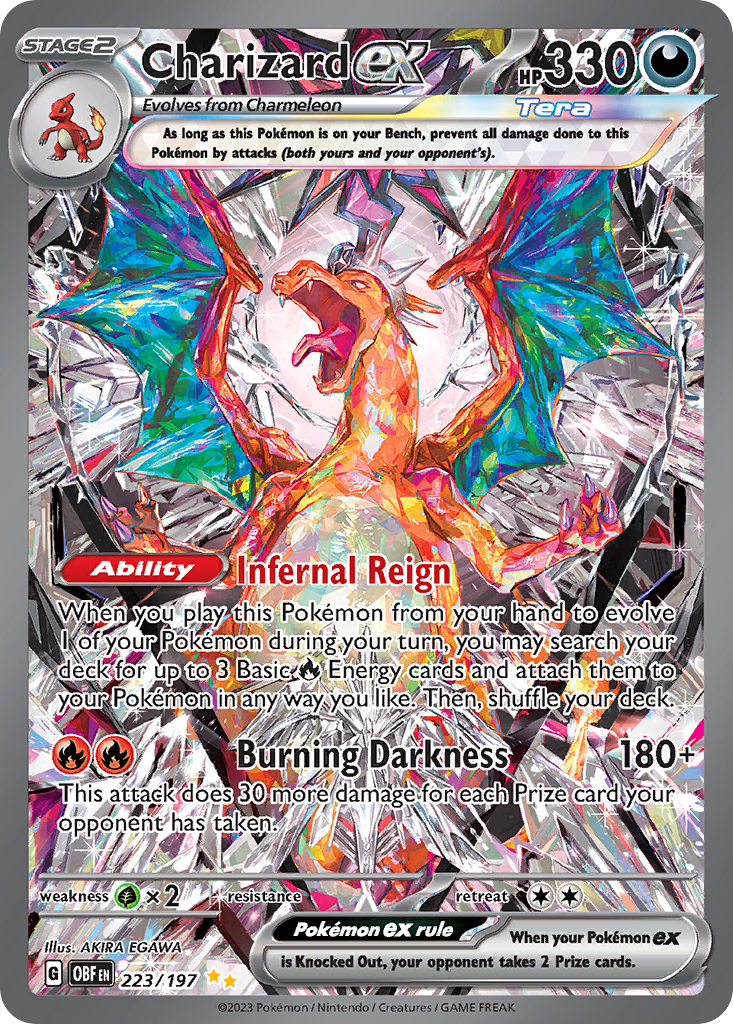
Charizard ex
Special Illustration Rare · EN
Use as a cross-source benchmark: movement matters more when TCGplayer, Cardmarket, and eBay agree.
Marketplace price check
Checking saved data



Next step: Confirm the card version and condition before comparing prices.
Catalog source: Pokemon TCG API card record - Reviewed 2026-07-09
What raw value means
Raw value is the practical market value of an ungraded card. The card may be pack fresh, lightly played, damaged, miscut, or somewhere in between. The value comes from what buyers can verify without a third-party label.
Raw value depends on:
- Set, collector number, language, finish, stamp, and variant.
- Condition, including corners, edges, surface, centering, and dents.
- Clear photos and seller trust.
- Recent sold prices for similar raw copies.
- Marketplace references from TCGplayer, Cardmarket, and eBay.
- Current supply and how hard the same card version and condition are to replace.
Raw does not mean low value. Many collectors prefer raw cards for binders, master sets, and display pages. Some cards are more enjoyable raw because the texture, holo pattern, and set context are part of the experience.
What graded value means
Graded value is the market value of a card after a grading company has authenticated it, assigned a grade, and sealed it in a holder. The grade can make the card easier to compare, but it does not make the value automatic.
Graded value depends on:
- The exact card, language, finish, and variant.
- The grading company and label.
- The assigned grade.
- Eye appeal within the grade.
- Recent sold prices for the same grade and company.
- Population, demand, and collector preference.
- The cost and time needed to grade comparable raw copies.
A PSA 10, PSA 9, CGC 10, and raw Near Mint copy are different comparisons. Even two slabs with the same number on the label can sell differently if one has stronger centering, cleaner holo, or better photos.
Why graded cards can be worth more
Grading can create a premium when buyers trust the grade and want the certainty or presentation of a slab. That premium is usually strongest when the card is hard to find in high grade, the grade is desirable, and recent sold prices show real buyer demand.
Common reasons graded cards sell higher include:
- Authentication reduces some buyer uncertainty.
- The holder protects and presents the card consistently.
- The grade creates a simple comparison point.
- High grades can be scarce for condition-sensitive cards.
- Some collectors build registry sets or slab-focused displays.
- Expensive cards may attract buyers who prefer third-party review.
The premium is not automatic. A low grade, common modern card, weak demand, or thin sales history can make grading add little value after fees, shipping, and time are considered.
Why raw cards can still be the better value
Raw cards often make more sense for collectors who care about set completion, binder presentation, or flexible buying. A raw card can be easier to store, scan, organize, and compare inside a broader collection.
Raw may be the better choice when:
- You want a binder copy, not a slab display.
- The graded premium is small or inconsistent.
- The card is common enough that supply is healthy.
- The card has condition flaws that limit grading upside.
- You would rather put the budget toward missing cards.
- You want to compare condition yourself before paying a slab premium.
This is especially true for master sets. A graded slab can be beautiful, but it does not fill a binder slot the same way a raw card does.
How to compare raw and graded prices
Do not compare the highest raw listing to the highest graded listing. Compare like with like.
Use this workflow:
- Identify the exact card: set, number, language, finish, stamp, and variant.
- Record whether your copy is raw or graded.
- For raw cards, compare against raw sales in similar condition.
- For slabs, compare against the same grading company and grade.
- Check recent sold prices, not only active asking prices.
- Review price references from TCGplayer, Cardmarket, and eBay.
- Ignore mismatched results, including wrong language, grade, or finish.
- Save the value with the card so the context is not lost.
For more on asking and sold prices, read asking price vs sold price for Pokemon cards.
Example: one card, three different values
Imagine an English modern chase card in strong raw condition.
| Version | How to think about it |
|---|---|
| Raw Near Mint | Compare with raw Near Mint sales and market references |
| PSA 9 | Compare with PSA 9 sales for the same card |
| PSA 10 | Compare with PSA 10 sales, but only if the card is already a PSA 10 |
The raw card may look clean, but it is not a PSA 10 until a grader says it is. If you value the raw copy at the PSA 10 number, your collection total becomes too optimistic. If you value a strong slab at the raw number, you may miss a real grade premium.
Common valuation mistakes
The biggest mistakes usually come from mixing categories.
Avoid these habits:
- Pricing raw cards as if they already earned a high grade.
- Using PSA 10 sold prices for PSA 9 or raw copies.
- Ignoring the grading company.
- Treating one old sale as the current market.
- Comparing Japanese and English copies without checking demand.
- Mixing reverse holo, stamped, promo, and standard versions.
- Using active asking prices as proof of value.
- Forgetting grading fees, shipping, and turnaround time when judging a potential premium.
Good valuation is not about finding the biggest number. It is about matching the right number to the card you actually own.
Where TCGplayer, Cardmarket, and eBay fit
TCGplayer is often useful for English raw singles, especially when there is healthy marketplace activity. Cardmarket adds European market context. eBay is especially important for recent sold results, scarce cards, and graded slabs.
Each reference has limits. TCGplayer may not capture every graded-card nuance. Cardmarket can show a different regional picture. eBay sold results can include outliers, weak photos, bundles, or mismatched titles. The answer gets better when you use the sources together and filter for comparable copies.
For a deeper marketplace comparison, read what market price actually measures.
How Unbinder helps
Unbinder is built around the collector workflow: identify the exact card, keep it organized, and track value with context.
Use Unbinder to:
- Scan cards into your collection.
- Keep raw and graded copies organized in digital binders.
- Track value references from TCGplayer, Cardmarket, and eBay.
- Watch value changes without relying on one listing.
- Use wishlists and missing lists to decide what should come next.
That makes raw versus graded value a practical collection detail instead of a spreadsheet argument.
Bottom line
Raw and graded Pokemon card values should be tracked separately. Raw cards are valued on visible condition and comparable raw sales. Graded cards are valued on the exact slab, grade, company, and recent buyer behavior.
If a graded premium is real, let the data show it. If the premium is thin, the raw card may still be the better collector choice.
FAQ
Is a raw Near Mint card worth the same as a PSA 9?
No. A raw Near Mint card and a PSA 9 slab are different market objects. Use raw comps for raw cards and PSA 9 comps for PSA 9 slabs.
Should I value a raw card as a PSA 10 if it looks perfect?
No. A raw card is not a PSA 10 until it has been graded. You can track it as a grading candidate, but your collection value should stay tied to realistic raw or likely-grade comps.
Do all graded Pokemon cards sell for more than raw cards?
No. A graded premium depends on the card, grade, grading company, demand, and recent sold prices. Some low-grade or common modern slabs add little value after fees and shipping.
Which source is best for graded Pokemon card values?
eBay sold items are often the most useful public source for slab comps because graded cards need exact grade and company matches. TCGplayer and Cardmarket can still help with raw-card or regional context.
How should I track raw and graded copies in Unbinder?
Track them as separate collection items with separate condition, grading, source, and value notes. A raw binder copy and a graded display copy should not share one value field.
Continue this workflow
How the Unbinder Market Reference works