Japanese vs English Pokemon cards
Japanese and English cards often look similar, but collectors should track them as different printings with different markets.
Japanese and English Pokemon cards are not two versions of one card. They are two printings with different release dates, different numbering, different supply, and different buyers. Track them as separate records and the awkward questions answer themselves: which one to buy, which one to grade, and why a price you found does not match the card in your hand.
The short answer most collectors need: for modern cards the Japanese printing is usually cheaper for the same artwork, and for vintage the English printing is usually worth more. Neither rule is a substitute for checking the exact card.
The language is part of the card's identity
A card is a set, a collector number, a language and a finish. Drop any one of those and you are no longer describing one object. Charizard ex 223/197 from Obsidian Flames exists in several languages, and the Japanese release of that artwork sits in a different set with a different number entirely, because the Japanese and international set structures do not line up.
That is why "Charizard ex from Obsidian Flames" is not a shopping instruction. Verify the number against the official Obsidian Flames card list (opens in a new tab) or the 151 card list (opens in a new tab), then record the language beside it. A collection that stores only the name will quietly merge two markets into one row.
Card showcase
One artwork, several language markets, one collector number each
Check the set and collector number, compare prices from each marketplace, and decide whether the card belongs on your wishlist or in your binder. One active listing is never the whole market.
Some marketplace links may earn us a commission at no extra cost to you. Compare condition, language, shipping, taxes, and sold results before buying.
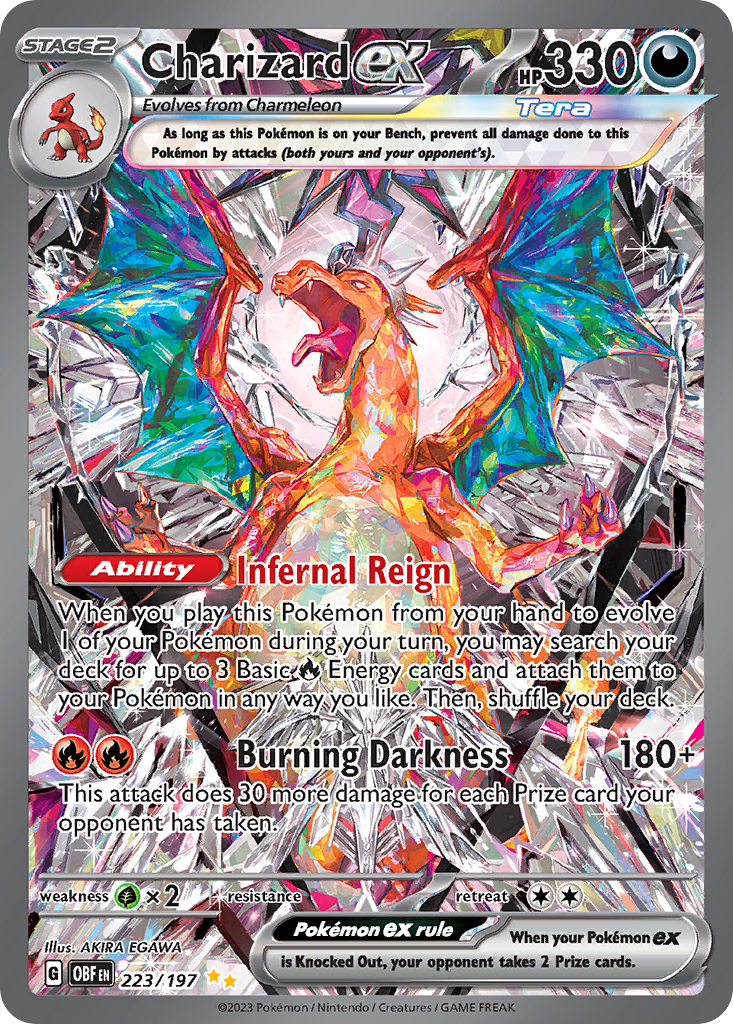
Charizard ex
Special Illustration Rare · EN
Use as a cross-source benchmark: movement matters more when TCGplayer, Cardmarket, and eBay agree.
Marketplace price check
Checking saved data



Next step: Confirm the card version and condition before comparing prices.
Catalog source: Pokemon TCG API card record - Reviewed 2026-07-09
What we measured: the same card, two language markets
We can show the effect rather than assert it, though not yet for Japanese. In Unbinder's frozen Cardmarket history, one ungraded near-mint copy of Charizard ex 223/197 was followed in two language markets over the same window, with every other field held identical: same card, same variant, same condition, same source, same metric, same currency.
| Exact card | Listing language | Metric | 4 July 2026 | 4 August 2026 | Change | Coverage |
|---|---|---|---|---|---|---|
| Charizard ex 223/197, Obsidian Flames, ungraded | German | Cardmarket asking average, NM | 109.34 EUR | 95.77 EUR | -12.41% | 24 saved price observations; start and end present |
| Charizard ex 223/197, Obsidian Flames, ungraded | English | Cardmarket asking average, NM | 128.21 EUR | 130.27 EUR | +1.60% | 24 saved price observations; start and end present |
One market fell twelve percent while the other rose slightly, in the same month, for the same printing. That is the whole argument for treating language as part of the card: a single number for "this card" would have described neither track.
Two honest limits. This is a German and English comparison, not a Japanese one, because our stored history covers the European marketplace where both languages trade side by side; a Japanese track needs its own frozen basket before we would publish a figure. And `asking_average` is the mean of active asking prices, not a completed sale, not a net after fees, and not a condition check on your copy.
Where the two printings genuinely differ
- Numbering. Japanese sets are smaller and released earlier, so the same artwork often carries a different collector number in each language. Mew ex 205/165 from 151 is an international number; the Japanese equivalent set is structured differently.
- Supply. Japanese product is printed for a domestic market and reaches European and American collectors through importers, which changes both price and availability without changing the card.
- Condition odds. Collectors widely report cleaner edges and fewer print lines from Japanese product. Treat that as a reason to inspect rather than a guarantee: it is a claim about averages, and you are buying one copy.
- Exclusives. Some Japanese promos and sets never receive an international release at all, so there is no English printing to compare against.
Which one to buy
Buy the Japanese printing when you want the artwork and the lowest price for a modern card, and you do not need it to complete an English set. Buy the English printing when it has to sit in an English set binder, when you plan to sell into a local market, or when the card is vintage, where English consistently carries the stronger market.
Do not mix them inside one set goal without deciding first. A binder that is "complete" with three Japanese substitutions is a fine collection and a misleading checklist, and the difference matters the day you sell it.
Before you compare any price
Fix the printing, then read what the number means. Cardmarket's price pages (opens in a new tab) describe a European market built from active listings, while TCGplayer's Market Price (opens in a new tab) is a rolling average of completed American sales. Comparing a Japanese card's price on one against an English card's price on the other tells you almost nothing, because two things changed at once.
Keep the language attached to the card in your own records, so the comparison stays possible later. If you want that context kept for you, open your collection and record the language when you add the card rather than afterwards.
Common mistakes
- Treating a shared artwork as a shared card.
- Comparing a Japanese price on one marketplace with an English price on another.
- Filling English set gaps with Japanese cards and still calling the set complete.
- Assuming Japanese always grades higher, on a single copy you have not inspected.
- Reading a vintage rule of thumb onto a modern card, or the reverse.
FAQ
Are Japanese Pokemon cards worth more than English ones?
It depends on the era. For vintage cards the English printing is usually worth considerably more; for modern cards the Japanese printing is usually cheaper for the same artwork. Both are generalisations, and the only thing that settles a specific card is checking that one printing in a single named market.
Can I use Japanese cards to complete an English set?
You can, and many collectors do. Just record it, because a checklist that counts substitutions as completions will mislead you later, most expensively at the point of sale.
Do Japanese cards really grade better?
They are widely reported to arrive with cleaner edges and fewer print lines, which raises the odds of a high grade. That is a statement about a population, not about the copy in front of you, so it changes how carefully you inspect rather than whether you inspect.
Why does the same card have a different number in Japanese?
Japanese sets are smaller and organised differently, and international sets combine them. The artwork survives the translation; the set and the number do not.
Continue this workflow
How to complete a Scarlet and Violet set