Pokemon card wishlist app: build an exact want list
A useful wishlist keeps this month’s binder gaps separate from someday cards and passing marketplace temptation.
A list that only says “Charizard” leaves you guessing at the seller table: which printing did you mean, and do you already own or expect a copy? A good Pokemon card wishlist app answers both questions by keeping the set, collector number, language, finish, condition target, and priority beside every want.
Start with a short list. Ten exact cards you can recognize and compare are more useful than a hundred names collected while scrolling.
If you still need to find the gaps, begin with how to make a Pokemon card missing list. This guide starts after that audit and asks whether the wishlist itself is good enough.
What a Pokemon card wishlist app should record
| Field | Useful example | Mistake it prevents |
|---|---|---|
| Set and collector number | Obsidian Flames 223/197 | Buying another Charizard with similar art |
| Language | English | Mixing languages in a set binder by accident |
| Finish or printing | Special Illustration Rare | Choosing a regular, reverse, stamped, or promo version |
| Condition target | Near Mint raw | Comparing the wrong condition or a graded copy |
| Quantity | One copy | Reordering a card that is already on its way |
| Priority | Buy next, trade for, or later | Letting every wanted card compete for this month's budget |
The exact card is the heart of the list. “Charizard ex 223/197, English, Near Mint” can be checked against a binder, a seller photo, and a marketplace record. “Charizard” cannot.
Once those details are correct, open your Unbinder wishlist and start with ten cards. A short exact list is easier to use at a seller table or during a trade than a long feed of cards you only vaguely like.
Keep the missing list and wishlist separate
A missing list answers: what is absent from this set or binder? A wishlist answers: which of those gaps do I actively want to solve?
That difference protects the fun. A master set may have 40 empty slots, while only five belong in this month's buying plan. The other 35 are still real gaps; they simply do not need to follow you into every card show or marketplace search.
Use three lanes:
- Buy next: affordable cards that finish a page or complete a small group.
- Trade for: cards worth carrying to a show or matching against duplicates.
- Later: expensive chases, condition upgrades, and someday cards.
A favorite card can stay in the later lane for a year without becoming a failed task. The wishlist should make patience easier, not make every card feel overdue.
One line, one printing
A want list earns its keep the moment it stops a duplicate purchase, and that only happens when each line names a printing. "Charizard ex" will let you buy Charizard ex 125/197 while the slot you meant was Charizard ex 223/197 from the same set.
Verify the number against the official Obsidian Flames card list (opens in a new tab) before the line goes on the list, and check what a quoted price actually measures in Cardmarket's price pages (opens in a new tab) before it becomes a budget.
Card showcase
A want-list line that names one printing
Check the set and collector number, compare prices from each marketplace, and decide whether the card belongs on your wishlist or in your binder. One active listing is never the whole market.
Some marketplace links may earn us a commission at no extra cost to you. Compare condition, language, shipping, taxes, and sold results before buying.
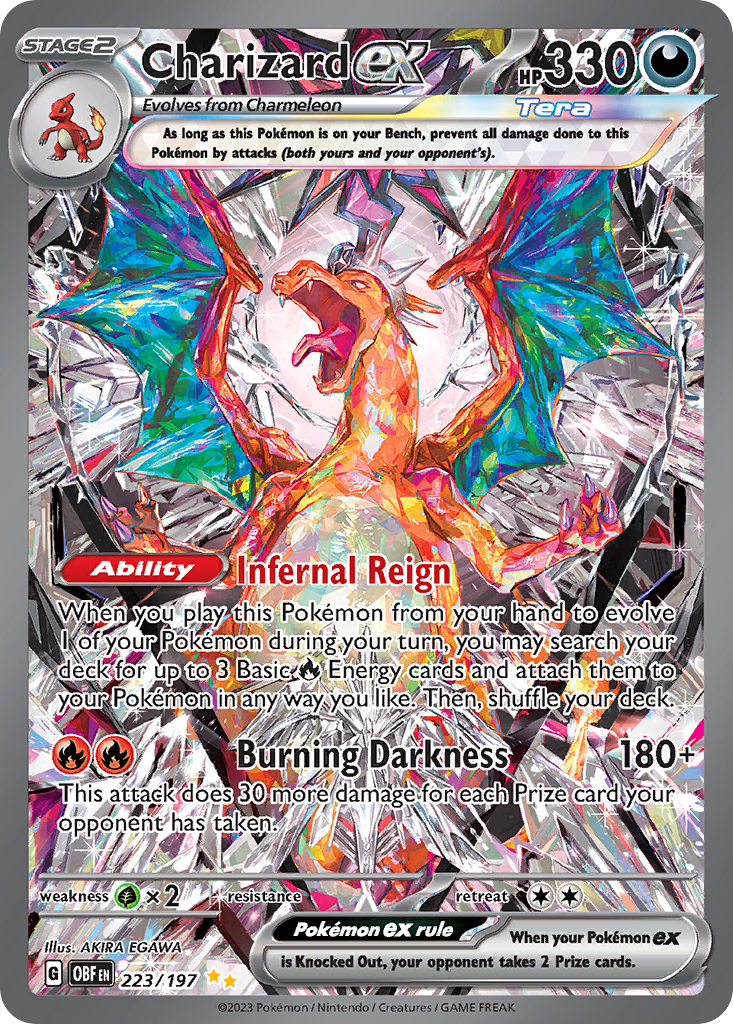
Charizard ex
Special Illustration Rare · EN
Use as a cross-source benchmark: movement matters more when TCGplayer, Cardmarket, and eBay agree.
Marketplace price check
Checking saved data



Next step: Confirm the card version and condition before comparing prices.
Catalog source: Pokemon TCG API card record - Reviewed 2026-07-09
Run a seven-printing wishlist test
Before moving a long want list into any app, enter seven cards whose names are easy to confuse. Use three Charizard ex printings from Obsidian Flames, three Mew ex printings from 151, and one Pikachu from 151:
| Test card | What the saved row must preserve |
|---|---|
| Charizard ex 125/197 | Obsidian Flames, Double Rare |
| Charizard ex 215/197 | Obsidian Flames, Ultra Rare |
| Charizard ex 223/197 | Obsidian Flames, Special Illustration Rare |
| Pikachu 025/165 | 151, plus the finish you actually want |
| Mew ex 151/165 | 151, Double Rare |
| Mew ex 193/165 | 151, Ultra Rare |
| Mew ex 205/165 | 151, Hyper Rare |
Check the fractions against the official Obsidian Flames checklist (opens in a new tab) and 151 checklist (opens in a new tab). Then add one card you already own, one that is incoming, and one wanted in a specific finish. Close the app, reopen the list, and confirm that the identity, state, and finish still mean the same thing. This is an input test, not a claim that one app is more accurate than another.
Check owned cards before adding another want
The strongest reason to use an app instead of a plain notes list is owned-card context. Before adding a target, check whether the card is:
- already in another binder;
- owned in a different language or finish;
- ordered but not yet filed;
- present as a lower-condition copy you intend to upgrade;
- duplicated and available for a trade.
This is where a beautiful marketplace listing can cause a dull mistake. The card may already be yours, just filed somewhere you did not check.
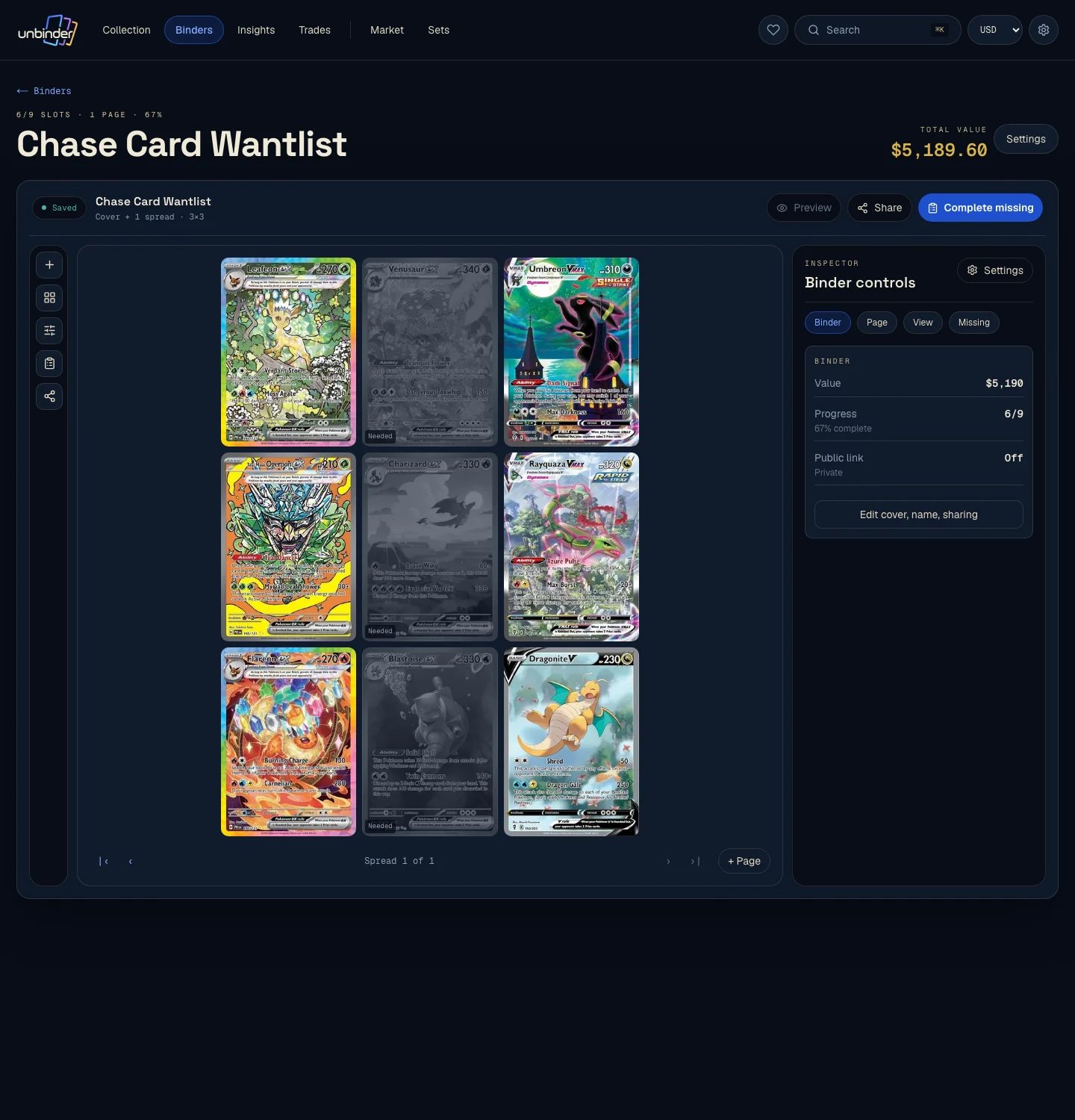
The Pokemon card collection tracker page shows how Unbinder keeps owned cards, binder gaps, duplicates, and wishlist targets in separate states. That context is what prevents a want list from becoming a second, disconnected collection.
Review the list at collecting moments
Do not turn wishlist maintenance into another hobby. Review it when something has already changed:
- after a pack opening;
- after a Cardmarket, TCGplayer, or eBay order;
- before a card show or trade night;
- when a set checklist changes;
- when a card arrives and moves into the collection.
Remove filled gaps and correct wrong versions immediately. A stale wishlist is worse than a short one because it can cause duplicate orders with complete confidence.
Use the wishlist at a card show or trade night
At a card show, the wishlist should answer one question quickly: is this the exact card I planned to find? Do not rebuild the list while standing at a seller table. Prepare the identity, priority, condition target, and budget before you leave home, then update the list after the card changes hands.
| Moment | Check | Decision |
|---|---|---|
| Before the show | Set, collector number, language, finish, condition target, and maximum budget | Keep only cards you would genuinely buy or trade for that day |
| At the table | Compare the physical card with the saved version and check whether you already own another copy | Buy, trade, ask for better photos, or walk away without editing the target |
| After the deal | Confirm the card that arrived, add it to the right binder, and remove the fulfilled want | Keep the list accurate before visiting the next table |
If you share the wishlist with a friend, expose only the card details they need to help. Keep private notes and budgets private, and turn sharing off when the card show or trade conversation is over.
Use prices as context, not priority
Price belongs beside a target, but movement alone should not promote a card. A dropping chase can still be outside your budget. A cheap common can deserve the first slot because it completes a favorite binder page.
For an expensive target, compare the same printing, condition, and language across the relevant marketplace. TCGplayer gives useful US singles context, Cardmarket is central for European supply, and completed eBay results can help inspect individual public sales. Read how to check Pokemon card sold prices before treating one number as a decision.
Share only the list you mean to share
A public wishlist is useful before a birthday, card show, or trade conversation. It is not a reason to publish private collection notes or your full budget.
Before sharing:
- remove cards you already bought;
- confirm the exact versions;
- keep private notes private;
- check that every visible card is genuinely wanted;
- turn sharing off when the link has served its purpose.
The cleanest shared list lets another collector answer one question: “Is this the exact card you are looking for?”
Common wishlist mistakes
- Adding a Pokemon name without the set and collector number.
- Mixing active purchases with long-term grails.
- Forgetting cards that are already ordered.
- Treating every empty master-set slot as equally urgent.
- Comparing different languages, finishes, or conditions.
- Leaving a filled gap on the list after the card arrives.
- Buying because a price moved instead of because the card still matters.
Bottom line
Choose a Pokemon card wishlist app that understands exact cards and can check them against what you own. Keep the active list short, split buying from trading and later goals, and review it at moments that already change the collection. The best wishlist does not create more wants; it helps the right card reach the right binder page.
FAQ
What is the best way to build a Pokemon card wishlist?
Start with an audited binder or set checklist, then add only the exact gaps you actively want. Record set, collector number, language, finish, condition target, quantity, and priority.
Is a wishlist the same as a missing list?
No. A missing list contains every gap against a collecting goal. A wishlist is the smaller group you currently want to buy, trade for, or watch.
How many cards should be on an active wishlist?
There is no universal limit, but ten exact targets are a strong starting point. Add more only when the list still makes the next buying or trading decision clearer.
Should I include prices in my wishlist?
Include a dated price reference or maximum budget when it helps, but do not let price movement decide whether the card belongs on the list.
Can I share a Pokemon card wishlist?
Yes. Share only the cards and details you want another person to see, remove filled gaps first, and disable the public link when you no longer need it.
What should I do when a wishlist card arrives?
Confirm the set, number, language, finish, and condition. Add the card to your collection, remove it from the active wishlist, and check whether it completes the intended binder slot.
Continue this workflow
Best Pokemon card collection app: choose by collecting goal