Best binders for Pokemon cards by collection type
Choose the binder around the page you are building, then test that page before moving the whole collection.
The best binder for Pokemon cards is a zippered, side-loading, fixed-page binder made from archival-safe materials. Choose a 9-pocket binder for most set collections, a 12-pocket binder for larger master sets or cleaner page layouts, a smaller 4-pocket binder for travel or kids, and a toploader binder only for cards that need rigid protection.
The brand matters less than the design. A good binder should protect sleeved cards, sit flat without crowding pockets, keep dust away, and make your collection easy to review. If a binder looks premium but makes cards hard to remove, encourages overfilling, or mixes trade cards into your main set, it is not the right binder for the job.
For a concrete product-spec reference, Ultra PRO's official 9-pocket Pokemon binder page (opens in a new tab) documents standard-card sizing, side-loading pockets, archival-safe acid-free non-PVC pages, and 360-card capacity. We checked that example on September 29, 2026. It is a specification reference, not a paid ranking or universal recommendation.
Quick recommendations
Use this as the short version before comparing specific products:
| Collector goal | Best binder type | Why it works |
|---|---|---|
| Completing a normal set | 9-pocket zip binder | Familiar page layout, strong protection, easy browsing |
| Building a master set | 12-pocket zip binder | More capacity and better layouts for variants |
| Keeping duplicates or trades | Separate 9-pocket binder | Protects your main collection from accidental movement |
| Protecting higher-value raw cards | Toploader binder or storage box | Adds rigidity after the card is sleeved and top loaded |
| Small collection or travel | 4-pocket zip binder | Easier to carry and less awkward for younger collectors |
| Budget sorting at home | Side-loading strap binder | Useful if the binder stays on a shelf and cards are not high value |
If you are still deciding how the collection should be organized, start with how to organize Pokemon cards before buying another binder. The binder should serve the system, not become the system.
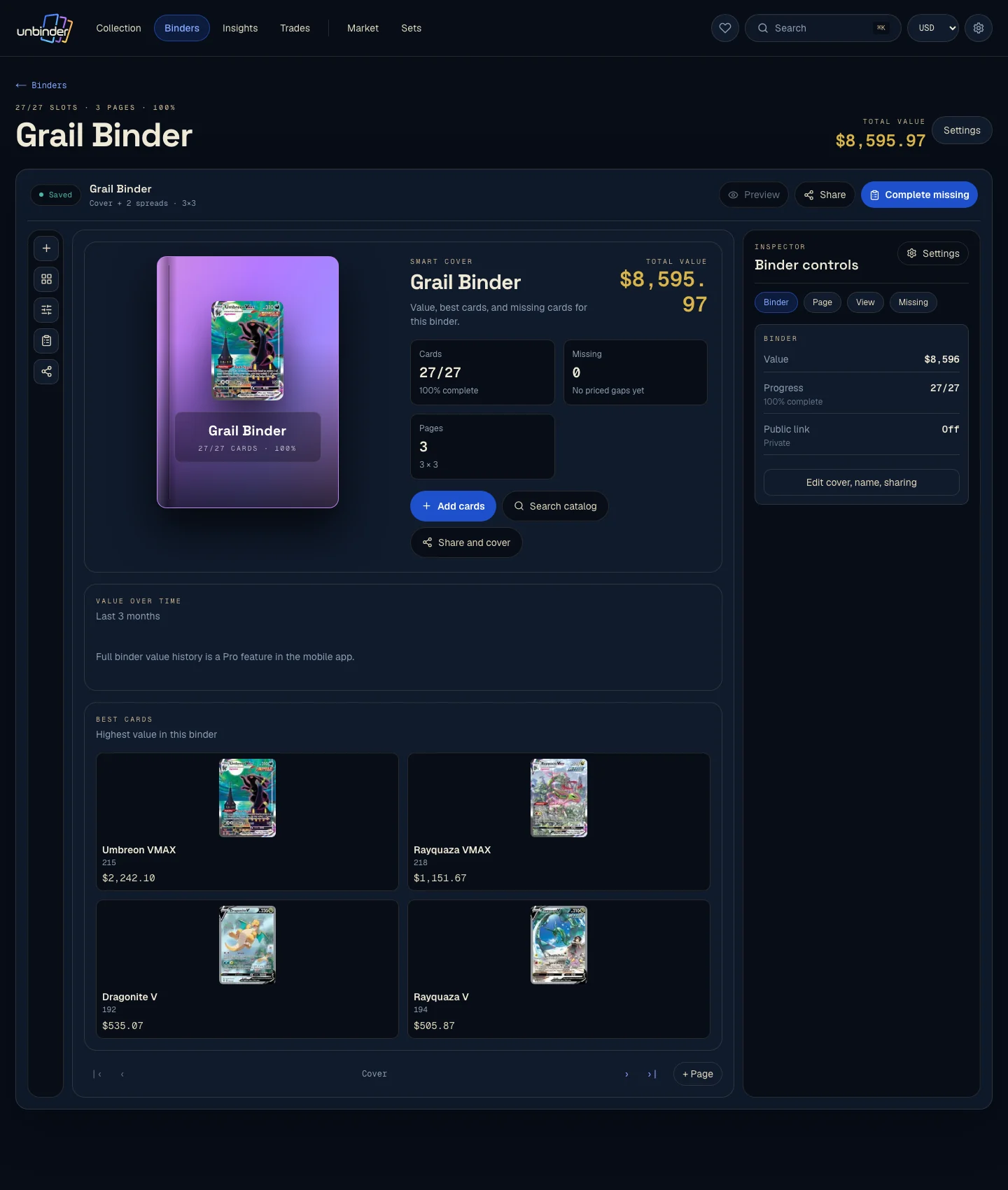
Run a nine-card 9-pocket test before moving the set
A binder is bought once and judged for years, so test it against the page you actually intend to build rather than an empty pocket. Use the same sleeves you plan to keep, and run this check before buying several binders or moving a whole collection:
- Sleeve nine cards: the four named test cards below and five ordinary cards. Use the same sleeve type throughout, and do not risk irreplaceable cards.
- With one 9-pocket page facing you, put Charizard ex 125/197 in the center pocket.
- Use the top-left pocket for Charizard ex 215/197.
- Place Charizard ex 223/197 in the top-right pocket. The two top corners expose edge pressure and page movement sooner than the center.
- Put the reverse-holo Pikachu 025/165 in the bottom-right pocket, then fill the other five pockets with ordinary sleeved cards. Never stack cards to simulate thickness.
- Close the binder and leave it flat for 24 hours. Then check every corner, page edge, and card face for pressure, bowing, or movement.
- Hold the closed binder upright, then gently turn it zipper-side down. Stop if a card shifts toward the pocket opening.
- Repeat with the binder about three-quarters full. A nearly empty binder does not show how the spine and pages behave in normal use.
For a 12-pocket binder, add three ordinary sleeved cards so the page is full, keep the named cards in the top-left, top-right, one inner, and bottom-right pockets, and repeat every check. A 9-pocket pass does not prove a wider page fits or moves the same way.
This is a fit and handling test, not a claim that a binder has been proven safe for decades. Reject the binder if a sleeved card needs force, a page bows when flat, a zipper presses on the page block, or cards migrate in normal handling.
Two things are worth reading from the source rather than from a round-up. Ultra PRO publishes its material and archival-safety notes (opens in a new tab). The official 151 card list (opens in a new tab) and Obsidian Flames card list (opens in a new tab) confirm the example printings and help calculate how many pages the collection will actually need.
Card showcase
The card whose safety decides which binder you buy
Check the set and collector number, compare prices from each marketplace, and decide whether the card belongs on your wishlist or in your binder. One active listing is never the whole market.
Some marketplace links may earn us a commission at no extra cost to you. Compare condition, language, shipping, taxes, and sold results before buying.
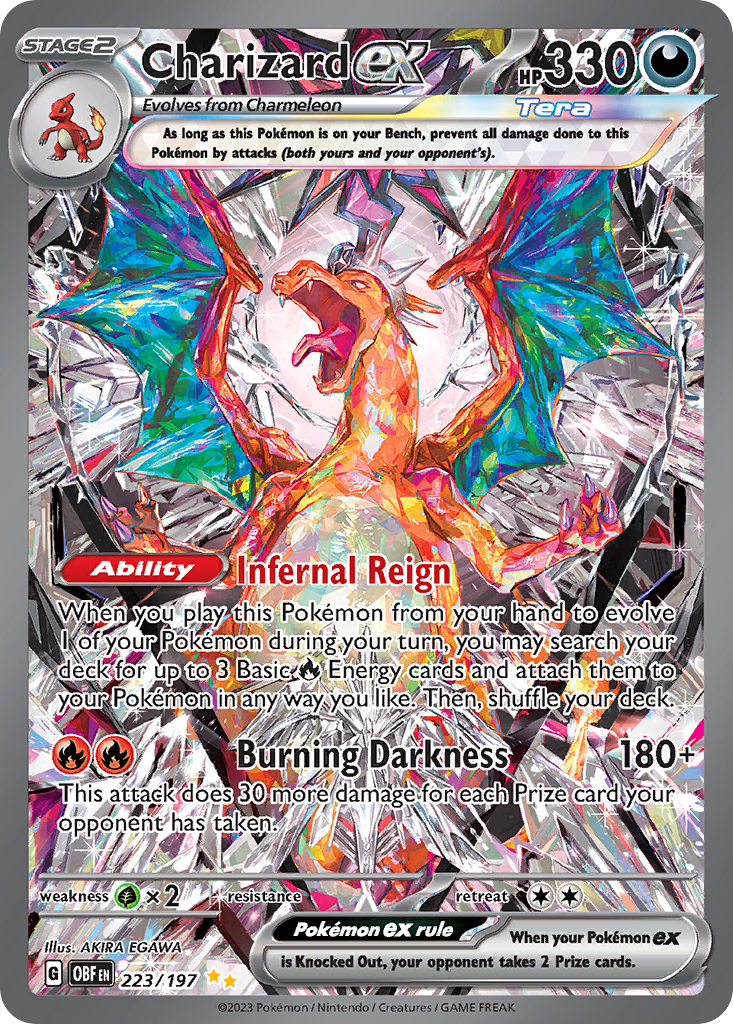
Charizard ex
Special Illustration Rare · EN
Use as a cross-source benchmark: movement matters more when TCGplayer, Cardmarket, and eBay agree.
Marketplace price check
Checking saved data



Next step: Confirm the card version and condition before comparing prices.
Catalog source: Pokemon TCG API card record - Reviewed 2026-07-09
What to look for in a Pokemon card binder
The best binders share a few practical traits:
- Side-loading pockets so cards are less likely to slide out.
- A zipper for stronger protection during storage and travel.
- Fixed pages instead of loose rings for most valuable collections.
- Archival-safe, acid-free, PVC-free materials where possible.
- Pockets that fit sleeved cards without forcing the corners.
- A cover that does not bend easily when the binder is full.
- Enough capacity for the goal without encouraging overstuffing.
- Clear page views so set numbers, art, and finishes are easy to inspect.
Pokemon cards are standard trading card size, so most standard-size card binders will fit them. The fit still changes once you add sleeves, double sleeves, or top loaders. Test a few cards before committing an entire set to a new binder.
Best for most set collectors: 9-pocket zip binder
For most collectors, a 9-pocket zip binder is the safest default. It is large enough for full set pages, compact enough to handle comfortably, and familiar enough that another collector can understand it quickly.
Choose this style if you are building:
- A set binder.
- A favorite Pokemon binder.
- A personal collection binder.
- A value-focused binder for cards you review often.
- A duplicate binder that stays at home.
Look for a fixed-page binder with side-loading pockets and a zipper. Products in this category often hold around 360 standard cards when using 20 double-sided pages. That is enough for many modern sets if you are not storing every reverse holo and variant in the same binder.
Avoid filling every pocket just because it is empty. Leave space for future pickups, promos, and cards still on your wishlist. A binder that can grow is easier to keep accurate.
Best for master sets: 12-pocket zip binder
A 12-pocket binder is better when the set plan is bigger than a simple one-card-per-number run. Master sets often include reverse holos, alternate finishes, promos, stamped versions, and language choices. A 12-pocket page can make those patterns easier to read.
Choose a 12-pocket binder if:
- You want each row to show a small group of related cards.
- You collect reverse holos next to regular versions.
- You need more capacity without splitting one set too early.
- You prefer wider pages for browsing at a desk.
The tradeoff is size. A 12-pocket binder is less convenient to carry and can become heavy when full. For a shelf collection, that is usually fine. For a trade binder or travel binder, a 9-pocket layout is usually easier.
If your goal is set completion, pair the physical binder with a Pokemon set checklist. The checklist keeps the page plan honest when variants start to blur together.
Best for trade cards: separate trade binder
Your trade binder should not be your main collection binder. Keep cards you may move in a separate physical binder and mirror that separation digitally.
A good trade binder is usually:
- 9-pocket.
- Side-loading.
- Easy to browse quickly.
- Filled only with cards you are comfortable discussing.
- Organized by set, Pokemon, rarity, value tier, or trade priority.
Do not put irreplaceable cards in a binder that will be handled at events, shops, or meetups. Even when the binder is well made, a trade binder sees more movement than a shelf binder.
For a full setup, read how to make a Pokemon trade binder. That guide covers what belongs in the binder, what should stay out, and how to prepare value references before a future trade conversation.
Best for valuable raw cards: toploader binder
A toploader binder is a specialized tool. It is not the best way to store every card, but it can be useful for higher-value raw cards that you want to browse without removing them from rigid protection.
Use a toploader binder for:
- Raw cards that already live in penny sleeves and top loaders.
- Cards you review often but do not want loose in normal binder pockets.
- A small value-focused collection.
- Cards waiting for grading research or a storage decision.
Do not use a toploader binder as an excuse to handle expensive cards casually. The card should still go into a soft sleeve first, then into the top loader, then into the binder pocket. The binder adds organization; the sleeve and top loader do most of the card-level protection.
For card-level protection choices, read best sleeves and top loaders for Pokemon cards.
Ring binders vs fixed-page binders
Traditional ring binders are flexible, but they are rarely the best premium choice for Pokemon cards. Rings can press into pages if the binder is stored poorly, and loose pages can shift more than fixed pages.
Ring binders can still work for:
- Low-value bulk organization.
- Temporary sorting.
- Checklists and notes.
- Collections where pages need to be rearranged constantly.
For serious set binders, favorite-card binders, and higher-value collections, fixed-page binders are cleaner and safer. They remove one common failure point: the page hardware.
How many binders do you need?
Most collectors are better served by several focused binders than one massive catch-all binder.
A practical setup:
- One binder for the main set or master set.
- One binder for favorite cards.
- One binder for trade or duplicate cards.
- One smaller binder or storage box for cards waiting to be sorted.
- Separate rigid storage for higher-value cards when needed.
This keeps each binder readable. It also makes updates easier after openings, singles purchases, or collection reviews.
In Unbinder, you can mirror this physical structure with digital binders. Scan cards into the right binder, keep missing cards in a wishlist, and use value references from TCGplayer, Cardmarket, and eBay to decide which cards deserve extra attention.
Common binder mistakes
Avoid these habits:
- Storing unsleeved cards in binder pockets.
- Overfilling pockets with multiple cards.
- Mixing trade cards into a set binder.
- Putting a heavy binder upright if the pages sag.
- Buying a binder before deciding the collection goal.
- Treating active listing prices as the same thing as real market value.
- Moving cards without updating your digital collection or missing list.
The most expensive binder mistake is not usually the product. It is losing track of what is supposed to be inside it.
How to choose before buying
Before buying, answer these questions:
- Is this binder for a set, master set, trades, favorites, or value storage?
- Will the cards be single-sleeved, double-sleeved, or top loaded?
- Does the binder need to travel?
- How many cards will the binder hold when the goal is complete?
- Do you need room for variants, promos, and duplicates?
- Will this binder be easy to update six months from now?
Then compare products by design, not just price. Premium binders usually earn their place when they reduce handling, protect corners, and make the collection easier to review.
Final recommendation
For most Pokemon card collectors, start with a 9-pocket zip binder with side-loading fixed pages. Move to a 12-pocket zip binder for master sets, choose a separate binder for trades, and reserve toploader binders for cards that need rigid protection.
Then build the digital layer around the physical one. Scanning a page into a digital binder gives you a second copy of the layout you just decided on, plus a dated price reference beside each card and a clean line between what you own and what you still need.
Continue this workflow
How to store Pokemon cards long term