Simplified Chinese Pokemon cards guide
Simplified Chinese Pokemon cards are a distinct collecting lane. Track them with language and region context from the beginning.
Simplified Chinese Pokemon cards should be treated as their own collecting lane, not as interchangeable copies of Japanese, English, or Traditional Chinese cards. The artwork may look familiar, but language, region, product structure, release timing, rarity, and market demand can all change how a card should be identified, organized, and valued.
If you collect across languages, keep the language and region attached to the card from the beginning. That habit protects your binder, wishlist, and price research from the most common mistake: collapsing different printings into one mental checkbox.
For a broader comparison, read Japanese vs English Pokemon cards. For organizing mixed-language collections, start with how to organize Pokemon cards.
Quick answer
Simplified Chinese Pokemon cards are official regional-language cards for collectors who want that specific language and market context. They can be beautiful, highly collectible, and sometimes easier or harder to source than nearby language versions depending on the card.
Do not price or track them as if they are automatically the same as English, Japanese, or Traditional Chinese cards. For each card, record:
- Language: Simplified Chinese.
- Region or release context.
- Set or product name.
- Collector number.
- Finish, rarity, stamp, or variant.
- Raw condition or graded label.
- Where the price reference came from.
Those details matter more than the character name alone.
Simplified Chinese is not Traditional Chinese
"Chinese Pokemon cards" is too broad for serious tracking. Simplified Chinese and Traditional Chinese cards are different language printings and may come from different regional release structures.
For collectors, that means:
- The same artwork can exist in multiple Chinese-language versions.
- A card name or set structure may not map cleanly across regions.
- Buyer demand can differ by language and location.
- Price references should match the exact language whenever possible.
- A listing title may say "Chinese" without enough detail.
When buying, ask for clear photos of the front, back, set symbol, collector number, and any product packaging if sealed.
Match a Simplified Chinese card to the printing you know
The quickest way to get comfortable is to line one up against an English card you already own. Charizard ex 223/197 from Obsidian Flames has a Simplified Chinese counterpart with the same artwork and the same place in the set, which makes the differences easy to see: the text, the copyright line, and the logo treatment change, the card identity does not. Pikachu 025/165 and Mew ex 205/165 from 151 work the same way, and between them they cover the three cases worth checking: a common, a card numbered above the set total, and a chase card.
Verify the English side against the official Obsidian Flames card list (opens in a new tab), and read the language and region rules on the official Pokemon TCG Asia site (opens in a new tab) rather than a shop's summary of them.
Card showcase
The English printing to hold a Simplified Chinese card against
Check the set and collector number, compare prices from each marketplace, and decide whether the card belongs on your wishlist or in your binder. One active listing is never the whole market.
Some marketplace links may earn us a commission at no extra cost to you. Compare condition, language, shipping, taxes, and sold results before buying.
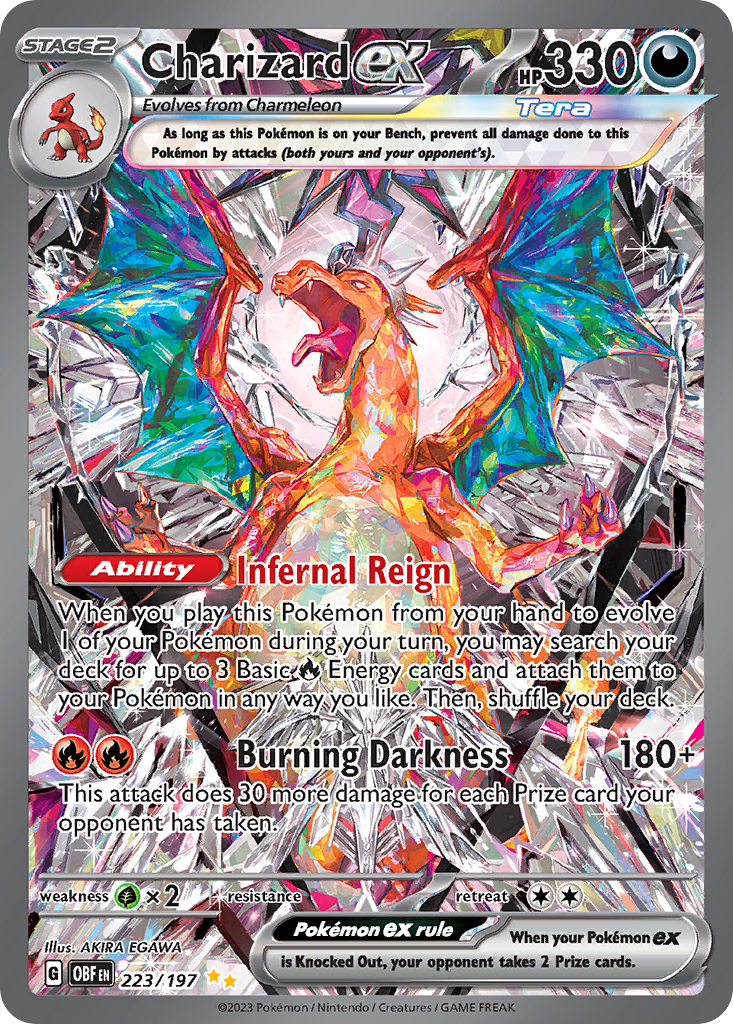
Charizard ex
Special Illustration Rare · EN
Use as a cross-source benchmark: movement matters more when TCGplayer, Cardmarket, and eBay agree.
Marketplace price check
Checking saved data



Next step: Confirm the card version and condition before comparing prices.
Catalog source: Pokemon TCG API card record - Reviewed 2026-07-09
Why collectors like Simplified Chinese cards
Collectors may choose Simplified Chinese cards for several reasons:
- They collect by language or region.
- They want a specific artwork in a different language.
- They enjoy regional product differences.
- They are building a global Pokemon binder.
- They want cards that feel less common in their local market.
- They are comparing value across languages.
None of those reasons is better than another. The key is to name the goal. A global language binder, a favorite-Pokemon binder, and an investment-minded slab collection all need different organization.
How releases can differ
Pokemon card releases do not always line up one-to-one across languages. Artwork, set names, numbering, rarity, promos, and product availability may arrive in different structures depending on the market.
That is why a familiar-looking card still needs its own identity. Do not assume that the English set name, Japanese set name, or Traditional Chinese version is enough to identify a Simplified Chinese card.
For a clean record, store the visible card details and the market context you used when you bought or valued it.
How to research prices
Pricing Simplified Chinese Pokemon cards can take more patience than pricing a common English raw single. Supply may be thinner, listings may use inconsistent language, and some marketplaces may have fewer clean comps.
Use a layered approach:
| Price question | Useful reference |
|---|---|
| What are sellers asking now? | Active marketplace listings |
| What did buyers recently pay? | eBay sold results where available |
| What is the English raw-card baseline? | TCGplayer, if the card has an English equivalent |
| What is the European collector context? | Cardmarket, where relevant |
| Is this card actually the same printing? | Photos, language, number, and set details |
Price references from TCGplayer, Cardmarket, and eBay can help frame the decision, but only after you confirm which printing you are holding. A price from another language is context, not a substitute.
Authenticity checks matter
Language-region cards can be harder to evaluate if you are less familiar with the text, product packaging, or release history. That does not mean you should avoid them. It means you should slow down.
Before buying, check:
- Clear front and back photos.
- Correct language and set details.
- Card texture, holo pattern, borders, and print quality.
- Seller history with Pokemon cards.
- Whether photos show the exact card, not a stock image.
- For graded cards, matching label, cert, grade, and card details.
- For sealed products, seals, box condition, and product identity.
If a listing is expensive and the photos are weak, ask for more photos or move on. A missed card is less costly than a bad copy.
Organization tips for mixed-language collectors
The biggest long-term mistake is storing language details only in your memory. Memory works for ten cards. It breaks when the collection grows.
Use a simple structure:
- Keep Simplified Chinese cards in their own binder or section.
- Label language and region clearly.
- Separate raw and graded cards.
- Store purchase notes when the price reference was unusual.
- Keep a wishlist for specific language targets.
- Do not merge different language printings into one set-completion count.
Unbinder is Pokemon-first and useful for building disciplined collection habits: digital binders, wishlists, missing lists, value tracking, and clean organization around the cards you collect. Chinese card support is in development, so collectors should keep language and region details separate and avoid assuming every Chinese-language card can be matched like an English or Japanese card.
What to record before you buy
For each target, write down:
- The exact Pokemon or trainer name you are seeking.
- The set or product context.
- Simplified Chinese as the required language.
- The collector number and visible rarity.
- Raw condition or desired grade.
- Your maximum price including shipping and taxes.
- The price references you used.
This keeps the purchase tied to a collecting goal instead of a vague listing that looks interesting in the moment.
Common mistakes to avoid
Avoid these habits when collecting Simplified Chinese Pokemon cards:
- Treating all Chinese-language cards as the same version.
- Using English prices as final values without checking language demand.
- Ignoring shipping, import costs, or seller location.
- Buying from vague listings with weak photos.
- Mixing Traditional Chinese and Simplified Chinese cards in your tracker.
- Assuming every familiar artwork has identical rarity across regions.
- Forgetting why you wanted the card before seeing a tempting price.
The fix is simple: slow down, identify the exact card, and organize it by the collection goal it serves.
How Unbinder fits in
Unbinder is built around the Pokemon collector workflow: organize cards into digital binders, track value context, and keep wishlists or missing lists for the cards you still want. For mixed-language collecting, the important habit is precision. Keep language, region, condition, and source notes visible wherever you manage the collection.
Because Chinese card support is still in development, use this guide as an educational framework rather than a promise of full Simplified Chinese catalog tracking. The collector principle is the same either way: different language printings deserve separate records.
For wishlist discipline, read how to build a Pokemon card wishlist and missing list. For value habits, read how to track Pokemon card collection value.
Bottom line
Simplified Chinese Pokemon cards can be a rewarding part of a global collection, but they need precise tracking. Record language, region, set, number, condition, and price context before treating a card as complete or fairly valued.
Collector-first organization makes the difference. The more clearly you record what the card is, the easier it becomes to buy carefully, value honestly, and enjoy the collection without confusion later.
Continue this workflow
How to complete a Scarlet and Violet set